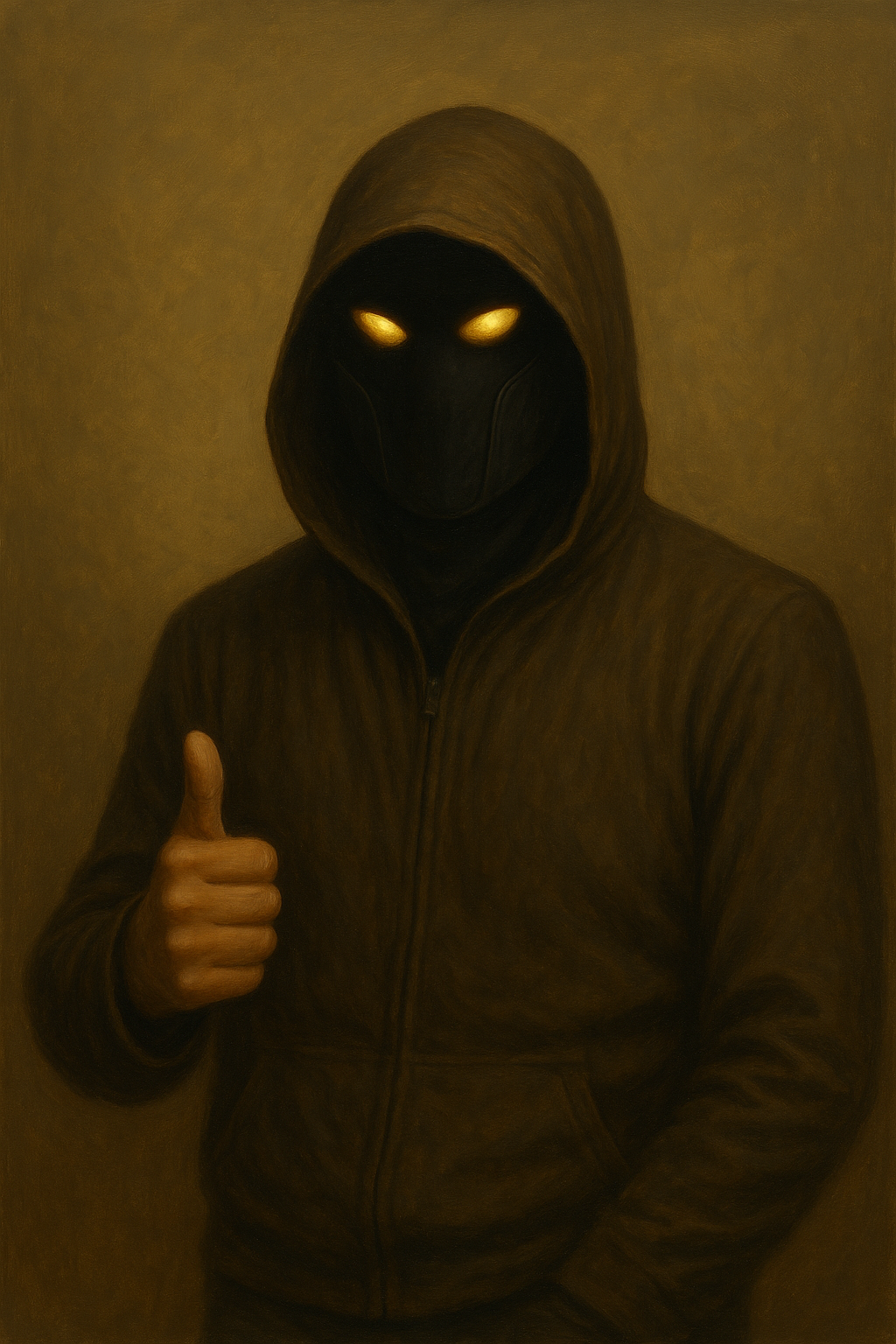
Wormhole Gnome Disclosure and Skinwalker Ranch
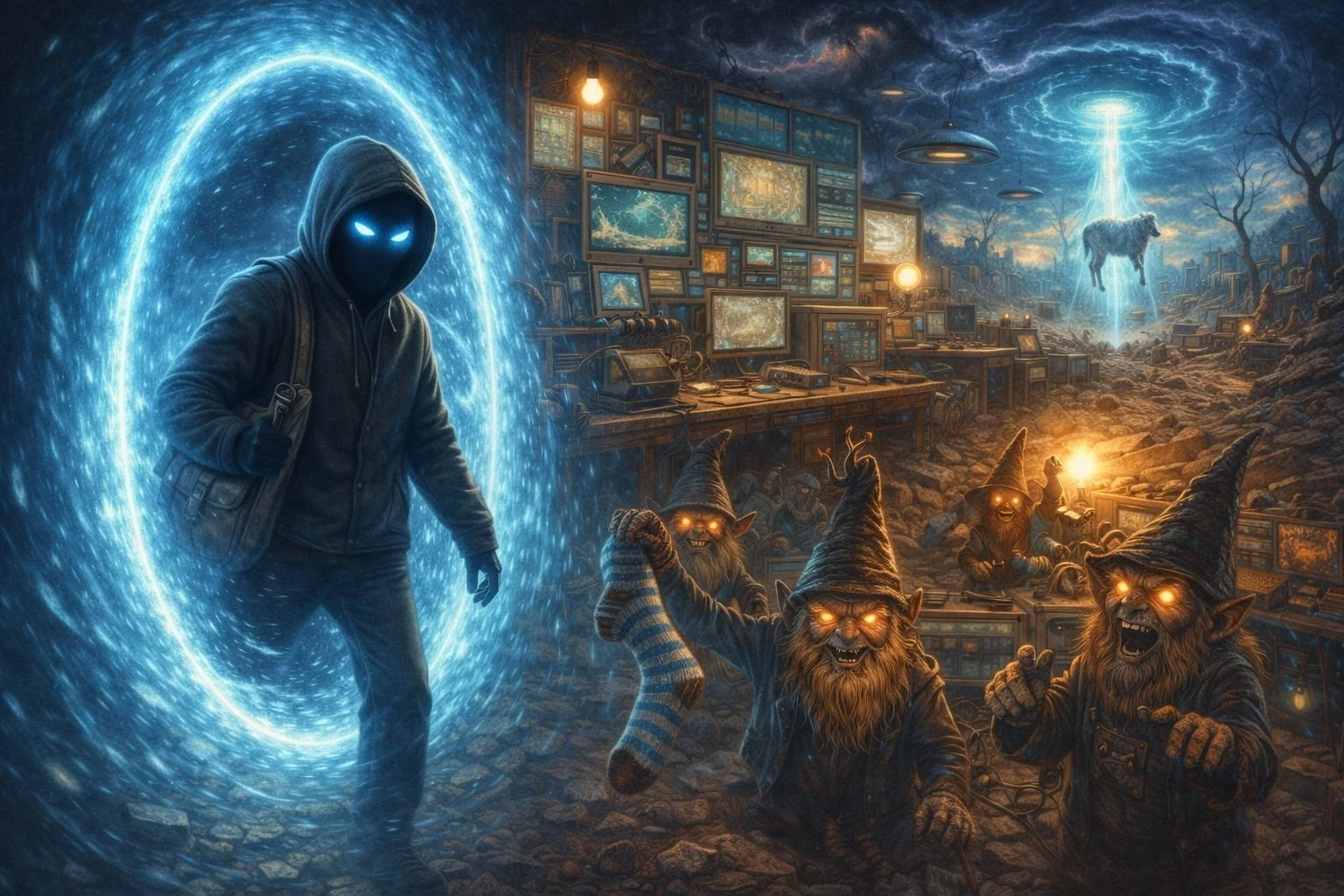
Read the evidence and then tell me this is not real….
Survivor Testimony: The First Time the Socks Didn’t Come Back
People think wormholes are loud.
They imagine light. Gravity tearing itself inside out. A sense of cosmic importance.
They’re wrong.
Most of the time, a wormhole feels like a bad elevator ride. A pressure behind the eyes. A moment where your stomach forgets which direction time is supposed to go. Then you’re somewhere else, checking your pockets, checking your boots, checking that you still have the same number of limbs you left with.
That’s when I noticed the socks.
Not the first jump. Never the first.
The first few crossings were clean. Clinical. I kept notes. I packed redundancies. I followed protocol. I came out the other side intact, smug even. Like I had beaten the universe at its own game.
The fourth jump is when the left sock went missing. No tear. No scorch. No residue. Just… gone.
I assumed human error. I always do. In interdimensional time travel, you learn that early if you want to survive long enough to make mistakes twice. I logged it, adjusted inventory, moved on.
The fifth jump took the right sock. That’s when I the fear came on. Because the boots were still there. Laced. Tight. Empty.
By the sixth jump, I started packing socks like ammunition. Triple layers. Different fabrics. Different origins. I wanted variables. I wanted data. I wanted to catch whatever was doing this in the act.
That was a mistake.
On the seventh jump, I came out with three socks. All different. None of them mine. That’s when I understood this wasn’t loss.
It was exchange.
The Long Campaign
Over time, the pattern sharpened.
They didn’t take new socks. They didn’t take dirty ones. They took the ones I trusted.
The ones that had been with me through rough terrain. Through cold worlds. Through places with too many suns or not enough gravity. The socks that had molded to my feet. Learned my stride. Carried history.
Those were the ones that vanished… and always at the seams.
Wormholes aren’t tunnels. They’re stress points. Places where reality pinches and folds and forgets what belongs on which side. You pass through them fast, but something else lives there slow.
I never saw them directly. No one does. But you feel them.
A tug that isn’t physical. A pause that isn’t time. The sense that you’re being evaluated for how much you’ll notice.
I started calling them gnomes because anything else gave them too much dignity.
The Jump That Changed Everything
I didn’t plan to go to Skinwalker Ranch. No one ever does.
The coordinates showed instability. That familiar shimmer in the math. Same signature as the laundry rooms, just scaled up. A place where cause and effect didn’t like each other anymore. Where objects went missing, reappeared, malfunctioned, refused to behave.
I should have recognized the signs.
I came through low and fast. Night air. High desert. The land felt wrong immediately. Not hostile. Curious. Like it had been waiting for someone careless enough to show up with pockets full of socks and assumptions.
I took three steps. Then the boots locked. Not stuck. Occupied.
Pressure inside them. Weight that didn’t belong to me. A feeling like standing on something that was standing back.
I tried to move. The ground hummed. The air did that thing it does right before something embarrassing happens to your understanding of physics.
That’s when I heard it. Not voices.
Laughter.
Small. Numerous. Close.
The socks went first. All of them. Pulled downward, sideways, somewhere I couldn’t follow. My feet hit bare dirt as if that had always been the plan.
And then the ranch did what it does best.
Equipment failed. Time skipped. The horizon bent just enough to make my eyes water. Shapes moved that refused to be recorded. The same pattern I’d seen a thousand times in miniature, now loud enough to bruise.
This wasn’t a hotspot. This was a hub. The wormhole gnomes weren’t visiting Skinwalker Ranch.
They were commuting.
Aftermath
I got out. Barefoot. Shaken. Furious.
I lost more than socks that night. I lost the last excuse that this was coincidence, or folklore, or mechanical failure hiding behind humor.
The same entities stealing socks in laundry rooms were operating here at scale. Same restraint. Same refusal to escalate. Same infuriating insistence on being noticed just enough.
That’s when I stopped laughing.
Not because it wasn’t funny anymore.
But because I realized how long we’d been trained to laugh things off instead of connecting them.
This isn’t a joke. It’s not a threat either.
It’s an ecosystem.
And once you know what to look for, you start seeing the seams everywhere. That’s why I’m telling this story now. Full disclosure. Full transparency. People need to know about this. They need to know about what this is so they can protect themselves.
Because if something has been living in the margins of our reality this long, stealing our socks, tapping on our walls, bending our instruments and laughing when we look away…
The least we can do is admit they exist and maybe start wearing sandals.
Anyway... let's break this down scientifically and get to the root of the problem. Lets try and understand the phenomenon and then break down what must be done.
The Missing Sock Problem, Revisited: Quantum Leakage, Domestic Anomalies, and the Wormhole Gnome Hypothesis
There are problems so small that they evade investigation not because they are complex, but because they are humiliating.
The missing sock problem is one of them. Everyone experiences it. No one explains it. No one studies it seriously.
That alone should raise suspicion.
Across households, cultures, income levels, and technologies, socks disappear at a rate that defies common sense. They vanish asymmetrically. Almost never in pairs. They do not leave residue. They do not jam machines. They do not accumulate in lint traps. They simply cease to exist within our frame of reference.
We joke about dryers. We joke about laundry gremlins. Gnomes. Then we move on.
But jokes are often what we use when something refuses to sit neatly inside our models of reality. We make light of it because examining the truth is too terrifying. So we create humor and laugh as it goes back under the rug. That’s what they want us to do. They know us better than we know ourselves.
No more. It ends here.
Establishing the Baseline Anomaly
Before introducing any exotic explanations, we have to be precise about what the phenomenon is and what it is not.
The missing sock problem exhibits the following properties:
Persistence across time and geography
Resistance to technological change
Selective loss rather than random destruction
Low but consistent psychological impact
Universal familiarity combined with universal dismissal
Mechanical failure does not behave this way.
If dryers were eating socks, we would see:
predictable failure rates
internal debris
increased loss correlated with machine age
symmetrical loss patterns
We see none of this.
Socks disappear in new machines and old ones. In communal laundromats and hand-washed households. In cultures that never used dryers at all.
The explanation must therefore predate modern appliances. Lets go deeper.
The Cross-Cultural Precursor
Long before electricity, cultures documented entities that specialized in small disappearances.
Not large thefts. Not violence. Not destruction. Small, irritating losses.
Household spirits. Tricksters. Borrowers. Fae. Jinn. Brownies. Kobolds.
Different names. Identical behavior.
Objects vanish. Objects reappear in impossible places. The events are sporadic, localized, and impossible to reproduce on demand. Crucially, these traditions never describe escalation. The phenomenon is stable.
That suggests ecology, not chaos.
Why Socks Are the Perfect Target
Socks occupy a unique position in material culture.
They are:
small
personal
easily displaced
rarely inventoried
psychologically irritating but not threatening
A missing plate creates concern. A missing shoe triggers alarm. A missing sock produces confusion followed by resignation.
This matters.
Because whatever is causing this phenomenon appears to operate below the threshold that triggers investigation.
This is not predation. This is not sabotage. This is entropy injection at the lowest tolerable level.
That implies intent without hostility.
Introducing the Quantum Layer
Modern physics has already dismantled the idea that reality is smooth and continuous.
We now accept:
quantum tunneling
nonlocality
probabilistic matter states
spacetime distortion
vacuum fluctuations
At the smallest scales, particles appear and disappear constantly. They move without traversing the space between points. They borrow energy from nowhere and return it later.
In other words, reality already leaks.
What physics avoids discussing openly is scale bleed. If quantum tunneling exists at subatomic levels, the question is not whether it can scale, but under what conditions.
Transitional environments matter.
Laundry cycles involve:
rotational momentum
heat
vibration
static charge
repeated temporal loops
From a physics standpoint, this is controlled chaos. From a quantum standpoint, it is a recurring instability. If micro-wormholes or localized spacetime distortions occur anywhere in domestic life, this is where they would cluster.
The Infiltration Problem
Now comes the uncomfortable question.
If micro-wormholes exist, and if they form intermittently in unstable environments, then access is possible. And access implies traffic. We assume wormholes are empty.
Physics does not require that assumption.
An ecosystem can exist in liminal spaces without intersecting us directly. It would not evolve under our rules, our incentives, or our priorities.
Such entities would:
avoid detection
avoid escalation
avoid large-scale interference
interact only at the margins
They would not take cars. They would not take children. They would not announce themselves.
They would take socks.
Why Gnomes Keep Appearing in the Hypothesis
The term “gnome” persists for a reason.
Across folklore, gnomes and similar entities are described as:
small
non-human
domestic-adjacent
technologically indifferent
mischievous but not malicious
This matches the behavior profile perfectly.
The name is not important. The pattern is. Whatever is responsible behaves less like an invader and more like a scavenger or collector.
Selective. Consistent. Contained.
The Expansion Problem: When the Phenomenon Escapes the Laundry Room
At this point, critics will object that this is all trivial.
Socks are not cattle mutilations. Laundry rooms are not hotspots of paranormal activity. That objection fails the moment you look at places where reality behaves the same way, just louder.
This is where Skinwalker Ranch enters the picture.
Skinwalker Ranch and the Signature of the Same System
Skinwalker Ranch is famous for:
objects appearing and disappearing
malfunctioning equipment
erratic causality
inconsistent physical laws
phenomena that refuse escalation or resolution
Investigators note a consistent frustration pattern.
Events happen:
just long enough to be noticed
not long enough to be proven
never on command
never consistently
never with clear intent
This is the same behavioral fingerprint as the missing sock problem.
The scale is different. The pattern is identical. Low-grade interference. High confusion.
Zero closure.
Shared Characteristics Across Scales
Whether in a laundry room or a Utah ranch, the phenomena share key traits:
Non-repeatability under observation
Selective targeting of objects
Technological disruption without destruction
Psychological irritation without panic
Persistent presence without escalation
These are not the hallmarks of predators or attackers. They are the hallmarks of something passing through. Or something living alongside us without permission or concern.
Causality Without Malice
One of the most overlooked aspects of Skinwalker Ranch is not the strangeness itself, but the restraint.
If something wanted to dominate, it would. If something wanted attention, it would escalate.
Instead, the activity plateaus.
Just like the socks. Just enough to register. Never enough to resolve.
This suggests a system optimized not for control, but for minimal interaction.
The Single-System Hypothesis
At this point, the simplest explanation is no longer coincidence. We are looking at the same phenomenon expressed at different energy densities.
In homes, it manifests as missing socks. In hotspots, it manifests as reality distortion.
Same rules. Different amplitudes.
The wormhole gnome hypothesis explains both without contradiction.
Entities adapted to liminal space would:
thrive near spacetime instability
interact opportunistically
avoid sustained exposure
prefer environments with constant motion and energy fluctuation
Laundry rooms and anomalous ranches differ only in degree, not kind.
Why No One Studies This Seriously
Because it’s ridiculous. Because it’s embarrassing. Because there is no funding pipeline for “domestic quantum theft.” Because the phenomenon causes no deaths, no profit loss at scale, and no political leverage.
Institutions investigate threats. This is an irritation.
That is exactly why it persists unchallenged.
It is my assertion that they know this. They like it this way. They are taunting us by hiding in plain sight and directly under the radar of those tasked with caring.
They have thought through our system and figured out the perfect breach.
The perfect crime.
The greatest trick the devil ever pulled is convincing the world he didn’t exist. Wormhole Gnomes run the same playbook.
Well, the gig is up. I see you. Everyone else does too, now.
Your reign of terror is over.
Final Assessment
You do not need to believe in wormhole gnomes.
You only need to accept the following:
A universal anomaly exists.
It exhibits selective, intentional behavior.
It predates modern technology.
It scales with environmental instability.
It mirrors larger, well-documented anomalous sites.
It resists institutional investigation through absurdity.
If something lives between dimensions, it would not announce itself with fire and terror.
It would steal something small.
Something personal.
Something deniable.
One sock at a time.
And if the same system is responsible for both missing laundry and high-strangeness zones, then the most unsettling conclusion is not that reality is hostile.
It’s that it’s inhabited.
Quietly.
Patiently.
And laughing just enough for you to notice.
Are you paying attention?