The Zombie Apocalypse Already Happened
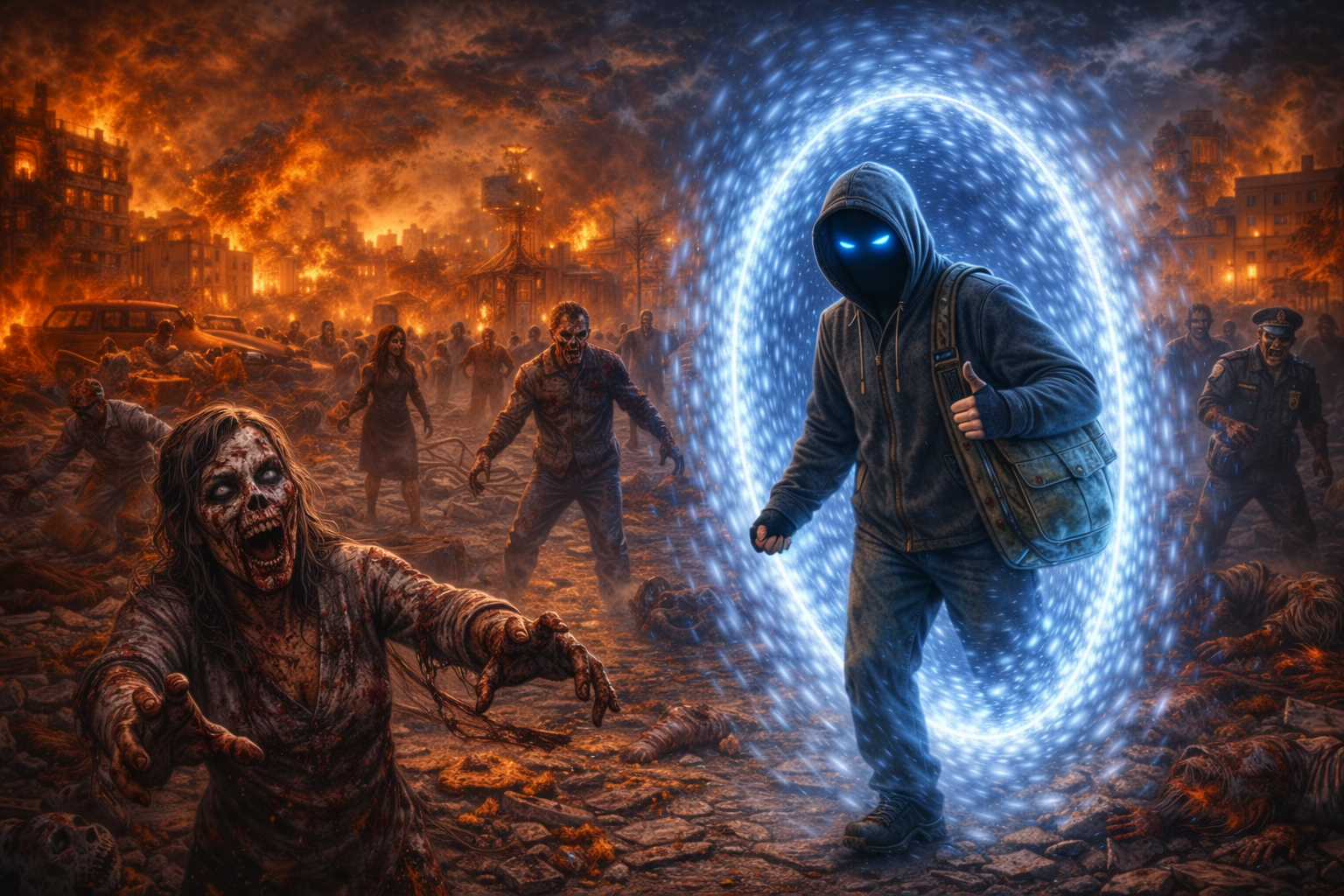
If you thought the zombie apocalypse was just in the movies… you clearly don’t hang out in the suburbs.
The Zombie Apocalypse Is Real
The sirens aren’t blaring. There are no barricades. No ash falling from the sky. No emergency broadcasts crackling through static. The stores are open. The Wi-Fi is strong. The drinks are cold.
And yet something is walking through the streets with dead eyes.
It doesn’t groan. It scrolls. It doesn’t chase brains. It chases stimulation. It doesn’t devour flesh. It devours time, attention, trust, legacy, meaning.
This isn’t a horror movie apocalypse. It’s a civilizational one.
The zombie apocalypse is not the collapse of infrastructure. It’s the collapse of time horizon. It’s what happens when millions of people unconsciously decide that nothing carries forward. When consequence is reduced to optics. When character becomes branding. When pleasure becomes purpose. When extraction becomes normal.
This isn’t about villains. It’s about operating systems.
When a culture internalizes “this is it” — when existence is framed as a one-shot chemical event followed by blackout — something subtle shifts. The long arc evaporates. Generational thinking feels quaint. Restraint feels foolish. Sacrifice feels irrational. If the lights go out forever, then of course you hit the pleasure button. Of course you optimize status. Of course you extract what you can.
YOLO isn’t rebellion. It’s logical consistency under a closed-loop worldview.
Now scale that logic across millions of people with unlimited digital dopamine, frictionless consumption, and systems engineered to amplify appetite.
You don’t get chaos overnight. You get something quieter. You get a society that forgets tomorrow. You get institutions hollowed out by short-term incentives. You get relationships reduced to transactions. You get leaders optimizing optics instead of outcomes. You get consumers rampaging through culture, demanding endless pleasure while starving their own development.
Idiocracy isn’t a punchline. It’s what happens when long arcs disappear.
This is the part that’s uncomfortable:
The zombie apocalypse doesn’t look like violence in the streets. It looks like comfort without growth. It looks like endless scrolling. It looks like outrage cycles that burn hot and vanish. It looks like dopamine loops masquerading as identity. It looks like people who are technically alive but spiritually anesthetized. And here’s the fracture line underneath it all:
Does anything carry forward?
If existence is closed, then pleasure is king and restraint is optional. If existence is open — if consciousness continues, if consequence echoes, if correction is real — then everything changes. Not politically. Structurally.
The difference between extraction and stewardship. Between casinos and cathedrals. Between YOLO and iteration. Between a culture that consumes itself and one that builds beyond itself.
The zombies aren’t monsters. They’re citizens who forgot tomorrow.
And the cure isn’t panic. It’s remembering that your actions might matter longer than your pulse.
Now let’s break down how we got here….
Surveying The Scene
If you’ve ever sat in a room and thought:
“This is fixable. Why are we making this harder than it needs to be?”
You’re not crazy. You’re probably operating on a longer clock than the room. That’s the real schism right now.
Not left vs. right. Not smart vs. dumb. Not rich vs. poor.
It’s this:
Does anything carry forward?
The Two Operating Systems
Operating System #1:
You are chemistry. Consciousness is a side effect. Death is blackout.
This is it. Optimize now.
That worldview produces YOLO culture.
Not because people are evil. Because if this life is a one-shot biological event, then maximizing pleasure, status, and security makes sense.
Short-term wins matter most. Reputation is branding. Character is optional. Extraction is rational.
If the lights go out at the end, why restrain appetite?
Operating System #2:
Consciousness is fundamental. You are more than a body. Actions carry consequence.
There is correction. There is continuation.
Call it reincarnation. Call it karma. Call it soul progression. Call it the world to come.
The details matter less than the implication:
This is not a closed loop.
Under that model, restraint isn’t weakness. It’s investment.
Integrity compounds. Distortion corrects. Avoided lessons return.
If you believe you will face the consequences of your actions beyond applause and beyond this lifetime, you behave differently.
You build differently. You think in generations.
YOLO and the Pleasure Button
Strip it down.
If nothing ultimately carries forward, then life becomes a stimulus-response loop.
Hit the pleasure button. Avoid pain. Accumulate advantage.
You don’t need philosophy to see where that leads.
It’s the monkey with the dopamine lever.
Push. Push. Push.
Until the system collapses.
Scale that to culture.
Endless scrolling. Endless consumption. Endless extraction.
Lord of the Flies isn’t dramatic fiction. It’s what happens when long arcs disappear. If tomorrow doesn’t matter, then take what you can today.
Scarcity becomes the default story. Zero-sum becomes common sense.
Fatalism Breeds Narcissism
This is the part no one wants to say out loud.
If death is annihilation and there is no structural consequence beyond social optics, then the rational center of gravity moves toward self. Not because people are monsters. Because fatalism collapses responsibility.
If this is your only run, why not prioritize yourself?
That’s not moral failure. It’s logical consistency. Now multiply that logic across millions of people.
You don’t get villains. You get narcissism through fatalism.
And over time, that erodes trust, competence, and coherence.
The Alternative: Correction
The spiritual model — whether you phrase it in religious terms or not — says something radically stabilizing.
You don’t escape yourself.
Avoided lessons return. Harm creates debt. Growth compounds. Character carries forward.
Whether that happens across lifetimes or across decades, the principle is the same:
There is no true shortcut.
You can delay correction. You can’t eliminate it.
That belief changes behavior. It encourages stewardship over extraction. It encourages iteration over indulgence. It encourages building something you may not personally benefit from.
That’s how civilizations get cathedrals instead of casinos.
Why the Schism Feels So Sharp
When you suggest long-term thinking in a YOLO environment, it doesn’t land as “wise.” It lands as “unnecessary restriction.”
When you suggest that actions echo beyond this moment, it sounds like superstition to someone who believes in blackout.
You’re not arguing about policy. You’re arguing about whether existence is closed or open. That’s a deeper divide than people admit.
Collapse and Correction
Yes, systems built on extraction destabilize. Yes, civilizations that abandon long arcs eventually fracture.
But this is not doom porn.
Correction is baked into reality. At the individual level, it looks like crisis forcing growth.
At the societal level, it looks like collapse forcing reset.
You can delay correction. You can’t outrun it.
That’s not punishment. That’s feedback.
So What Do You Do?
You stop trying to win debates about metaphysics. You start living from the operating system you believe in.
If you believe in continuation, act like it. Build for generations.
Refuse to subsidize self-sabotage. Invest in people who think beyond next quarter. Reduce dependency on systems addicted to extraction.
Pop your popcorn kernel.
Let the rest of the bag do what it does.
The Quiet Choice
If materialism is right and everything fades to black, integrity still improves the only life you get.
If materialism is incomplete and you return, integrity matters even more.
Either way, YOLO culture is unstable.
Iteration culture is durable.
Fatalism breeds scarcity.
Long arcs breed abundance.
The zombie apocalypse isn’t monsters in the street.
It’s a civilization that forgot tomorrow.
The antidote isn’t panic.
It’s remembering that existence might be larger than one lifetime.
And behaving accordingly.